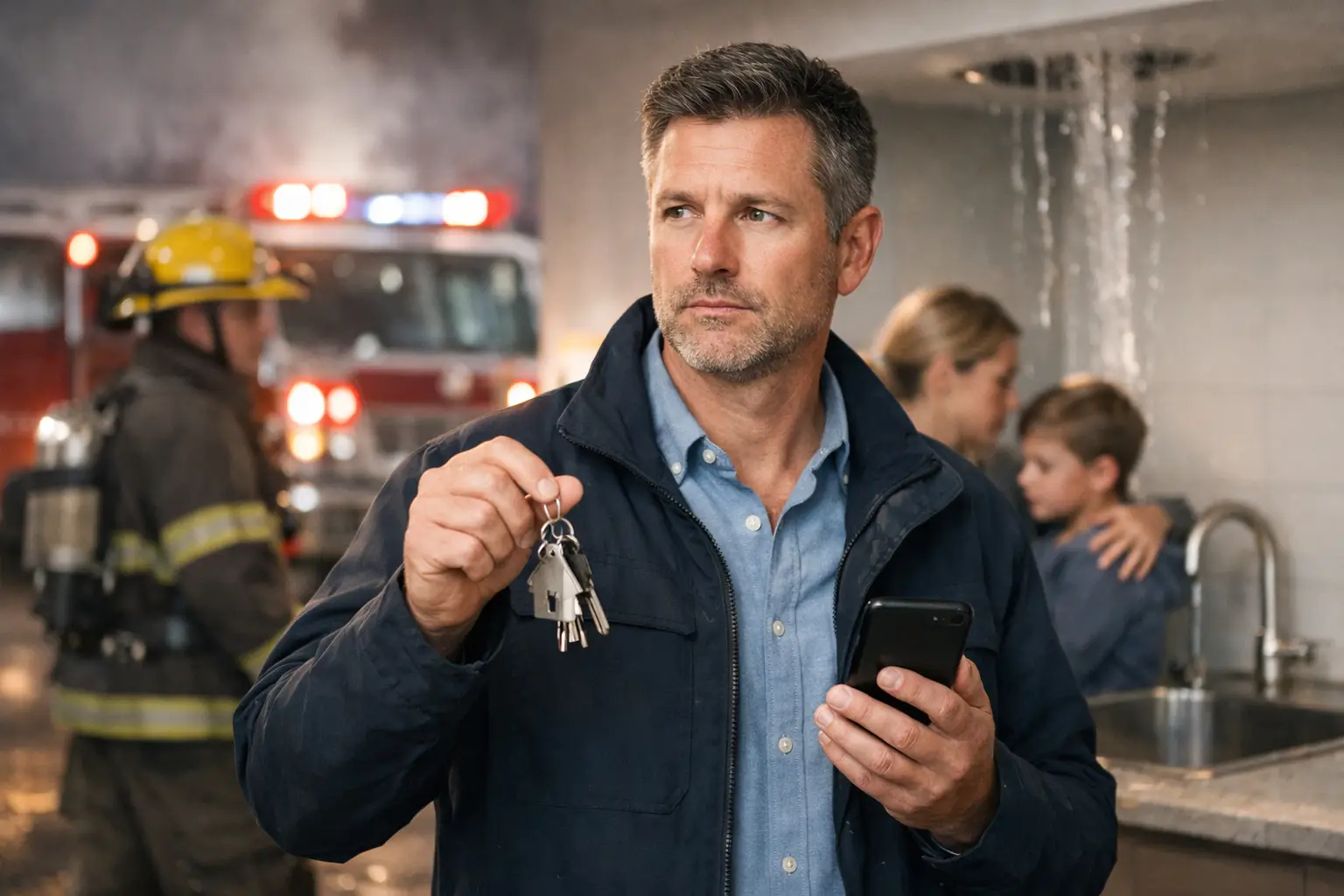
A rental property emergency does not wait for business hours. A pipe bursts at midnight. A tenant calls about smoke coming from an electrical panel on a Sunday. The air conditioner fails during a heat advisory in July. How a landlord responds in the first hour determines how much damage occurs, how much the repair costs, and whether the tenant relationship survives the incident.
This landlord emergency response guide walks through the decisions that matter most - what qualifies as an emergency, how to act quickly without acting blindly, how to communicate with tenants under pressure, and how to document everything so the property and the lease are protected when the situation is resolved.
What Counts as a Rental Emergency?
Not every maintenance call is an emergency. Knowing the difference between an urgent repair and a genuine emergency helps landlords prioritize correctly and avoid over-reacting to routine issues while under-reacting to serious ones.
A rental emergency is any condition that poses immediate risk to tenant safety, causes active property damage, or makes the unit uninhabitable. Common examples include burst pipes, flooding, complete loss of heat or air conditioning in extreme weather, gas leaks, electrical hazards, fire damage, sewage backup, and structural failure. A broken window latch in a ground-floor unit during a storm can also qualify depending on circumstances.
A maintenance issue, by contrast, is a problem that needs attention but does not create immediate danger or damage. A slow-draining tub, a running toilet, a single broken outlet in a room with others functioning - these need to be scheduled, but they are not emergencies. Treating them as emergencies creates cost, confusion, and after-hours rates that add up over time.
The practical test: is the problem getting worse by the hour, or is it stable until a scheduled repair? A slow drip is a maintenance issue. A pipe running water through a ceiling is an emergency. When in doubt, treat it as an emergency until proven otherwise.
The First 15 Minutes: Stabilize the Situation
The first 15 minutes of a rental emergency are the most consequential. The goal is not to fix the problem - it is to stop it from getting worse while the right help is on the way.
Start by confirming the tenant is safe. If there is any risk of personal injury - gas, electrical hazard, structural damage, fire - the tenant should be out of the unit before anything else happens. Property is replaceable. Safety issues escalate without warning.
Once safety is confirmed, identify the source of the problem. For water emergencies, that means locating and shutting off the nearest water supply valve - under the sink, at the toilet, or at the main shutoff. For electrical issues, that may mean cutting power to a circuit at the panel. For gas concerns, the tenant should leave immediately and the gas company should be called, not the landlord's maintenance contact.
Do not wait for more information before acting. The cost of one unnecessary after-hours service call is far lower than the cost of one hour of uncontrolled water damage. Make the call, get someone moving toward the property, and gather details while help is in transit.
Dispatch the Right Trade, Not the Nearest Guess
Emergency response fails most often not from slow reaction but from dispatching the wrong contractor. Sending a handyman to a plumbing emergency, or a general maintenance crew to an electrical panel issue, wastes time and may make the situation worse.
Every landlord should maintain a contact list of licensed emergency trades before an emergency occurs. That list should include a 24-hour plumbing repair service, a licensed electrician available for after-hours calls, an HVAC contractor with emergency service, and a water damage mitigation company. For properties in Marion County and the surrounding Tri-County area, knowing which providers can actually respond overnight versus which ones only claim to is essential.
Match the problem to the trade. Active flooding from a broken supply line goes to a plumber. Water that has already entered the structure and needs to be extracted and dried goes to a water damage restoration company. HVAC failure in peak Florida summer goes to an HVAC contractor, not a general handyman. A tripped breaker that does not reset goes to an electrician, not a repair crew.
When the right trade is dispatched immediately, repairs are completed faster, the scope of damage is smaller, and the documentation that follows is cleaner. When the wrong trade shows up first, there is often a second dispatch, a longer delay, and a more complicated repair chain.
Communicate Like the Owner Is on Site
Tenant communication during an emergency is as important as the physical repair. A tenant who receives no response after reporting an emergency is a tenant who calls an attorney, withholds rent, or leaves the lease. A tenant who gets a clear, consistent update every step of the way is a tenant who stays calm and cooperates with the repair process.
Acknowledge the report immediately. Even if you cannot dispatch someone for 30 minutes, confirm that you received the message, that you understand the situation is urgent, and that you are working on it. That one message changes the entire tone of the interaction.
Give the tenant a realistic first-response timeline. If a plumber will arrive within two hours, say that. Do not promise 30 minutes and deliver in three. Missed timelines during emergencies create distrust that is hard to recover from even after the repair is complete.
Update the tenant as each step is completed - vendor dispatched, vendor on site, source identified, repair underway, repair complete. When the emergency is resolved, confirm it in writing. A text or email that says "the plumber finished at 11:45 PM - water is shut off and the pipe is repaired, we'll schedule follow-up repairs for the drywall by end of week" creates a record that protects everyone.
Radio silence during an emergency is one of the most common causes of tenant complaints, lease-break requests, and landlord-tenant legal disputes in Florida. Communication is not extra work - it is the cheapest form of dispute prevention available.
Document Every Stage of the Emergency
Every rental emergency should be documented from the first report to the final repair. This is not optional. Documentation protects the landlord in tenant disputes, supports insurance claims, demonstrates reasonable response for legal purposes, and creates a record of what decisions were made under pressure and why.
Photos should be taken at four points: at the time of the initial report (if possible), after mitigation is complete, during the repair process, and after full restoration. Written notes should capture the timeline of events, the name and contact information of every vendor involved, the cost of each service call, and a summary of all tenant communications.
If the emergency leads to an insurance claim, the adjuster will want to see evidence that the landlord responded promptly and took reasonable steps to prevent further damage. A well-documented emergency - including timestamps on photos and written records - can be the difference between a covered claim and a disputed one.
For properties managed under a formal property management agreement, all emergency documentation should flow into the property's maintenance file. Future decisions about repairs, capital improvements, or lease terms often depend on the history of how the property has been maintained and how emergencies have been handled.
Restore the Unit, Not Just the System
Emergency response ends when the system is stabilized, but the landlord's responsibility does not. After a plumber stops the flood, there may be water-damaged drywall, ruined flooring, wet insulation, and personal property concerns from the tenant. After an HVAC failure during a Florida summer, the unit may need a deep clean and air quality check after the system is restored. After a sewage backup, the affected areas require proper sanitization before the unit is safe to occupy.
Restoration is a separate phase from mitigation. Mitigation stops the damage. Restoration returns the unit to its pre-damage condition. Both are the landlord's responsibility under Florida law, and the timeline for restoration matters. Florida statutes require landlords to maintain rental units in a condition that meets basic habitability standards. An extended delay in completing restoration work - even after the emergency source is resolved - can expose landlords to rent reduction claims or lease termination rights.
Work with your maintenance and restoration contacts to establish a clear scope of work for full restoration before the emergency response billing is finalized. This prevents situations where the structural repair is complete but cosmetic damage or hygiene concerns are left unaddressed, making the unit feel unfinished even when it is technically functional.
Also consider the tenant's experience during restoration. If work requires extended access, loud equipment, or temporary disruption to a room or system, communicate that clearly and provide a completion date. A tenant who feels informed and treated fairly during an inconvenient repair is more likely to renew - and less likely to leave a review that focuses on the emergency rather than the response.
Build Your Landlord Emergency Response Guide Before the Call
The worst time to build an emergency response process is during an emergency. Landlords who have a written guide, a tested vendor list, and a clear communication protocol before the first emergency call handle crises faster, at lower cost, and with far less stress than those who improvise under pressure.
A basic landlord emergency response guide should include the main water shutoff location for every property, the electrical panel location and labeling, the gas shutoff location if applicable, the after-hours contact for each critical trade, a copy of the tenant's emergency contact information, and the insurance policy number and claims contact for each property.
That information should be accessible on a mobile device. A document saved only on a desktop computer at the office does nothing when you are getting an emergency call at 10 PM on a Friday. Store it in a cloud-based note, a shared folder, or a property management platform that can be accessed from anywhere.
Review the guide after every emergency. Every real incident reveals something the written plan did not anticipate - a vendor who did not answer, a shutoff valve that was blocked, a tenant who did not know the water main location. Updating the guide after each use turns emergency response into a system that improves over time rather than a reaction that repeats the same gaps.
R&M Services & Property Management helps Marion County landlords build and maintain the vendor relationships, documentation systems, and maintenance protocols that make emergency response faster and more effective. When an after-hours call comes in, the right contacts, the right process, and the right communication can turn a potential crisis into a resolved problem by morning.