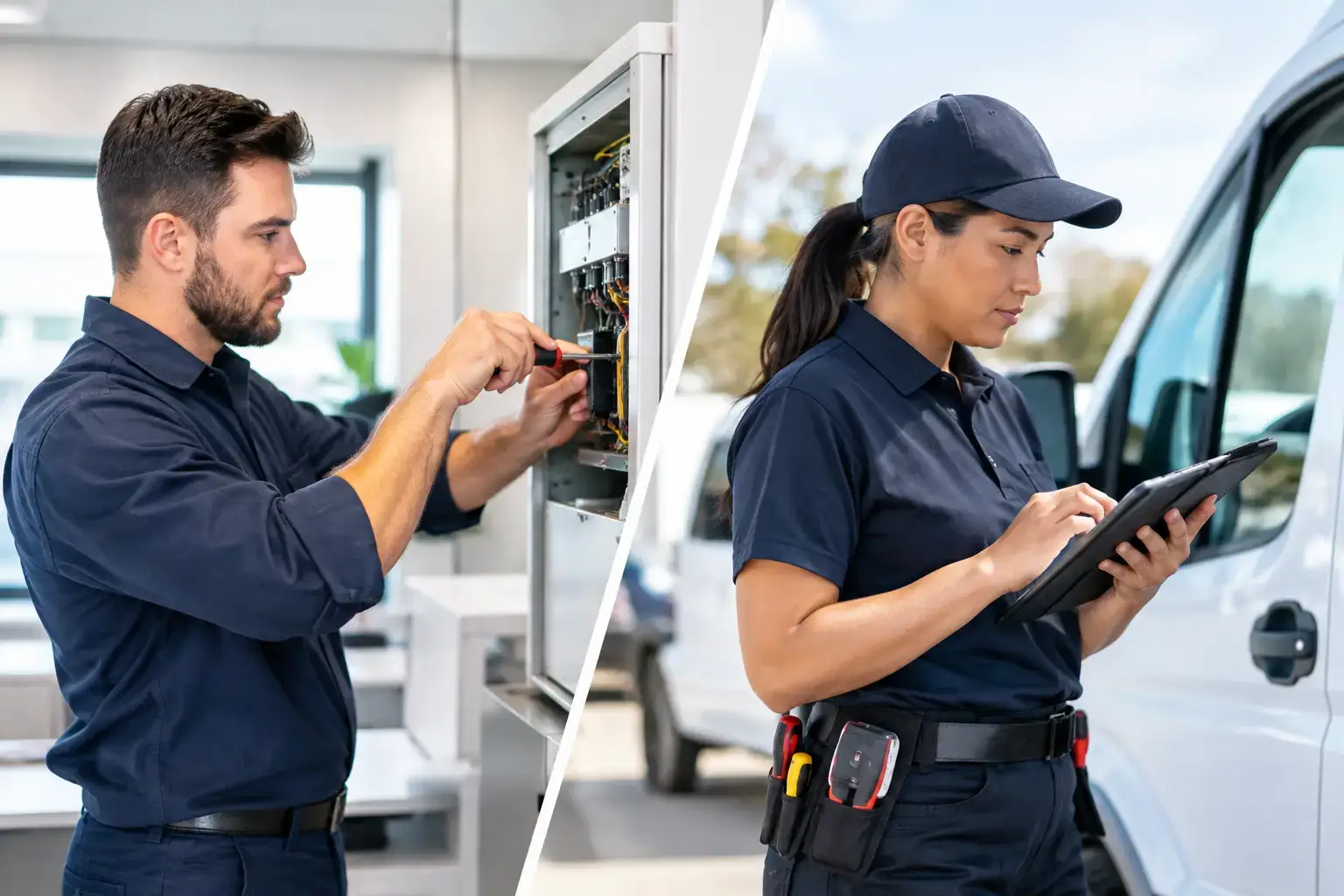
A leaking water heater at 8 p.m. does not care how your maintenance department is structured. But the in-house versus outsourced maintenance decision determines whether someone answers, who has the authority to act, and how long your tenant or customer waits. For owners, landlords, and property managers, the real question is not which approach sounds cheaper on paper. It is which one keeps the property operating without turning every repair into another job on your desk.
Both models can work. The better fit depends on your portfolio size, the type of properties you manage, the volume of requests, and how much operational responsibility you are prepared to carry.
What In-House Maintenance Really Requires
In-house maintenance means your company employs or directly manages its own technicians. At first glance, it creates control. Your team knows the properties, understands recurring issues, and can respond without waiting for an outside vendor to accept the job.
That control can be valuable for a large apartment community, a commercial campus, or a portfolio with enough steady repair volume to keep technicians busy every week. A familiar maintenance person may spot a failing toilet fill valve before it becomes a water-damage claim, recognize which unit has an aging HVAC system, and build trust with residents through consistent service.
The challenge is that payroll is only the visible cost. An in-house operation also means recruiting, training, scheduling, supervising, providing vehicles and tools, carrying insurance, managing workers' compensation, and covering absences. You still need a plan for specialized work that exceeds your team's skills or licensing.
One employee may handle minor drywall repairs, lock changes, basic landscaping, and everyday service calls well. That same employee may not be qualified to address electrical faults, major plumbing failures, HVAC diagnostics, roof damage, or a multi-unit turnover on a tight deadline. When work slows down, you still carry the labor expense. When work piles up, your staff can quickly become the bottleneck.
When an In-House Team Makes Sense
An internal team is often a strong choice when maintenance demand is predictable and concentrated. If you oversee a large number of units in one location, technicians can move efficiently from one request to the next. There is less windshield time, fewer handoffs, and more opportunity for preventive work.
It also makes sense when your properties have highly specific operating requirements. A senior living community, hospitality property, or facility with specialized equipment may benefit from staff who understand the site, its systems, and its resident expectations.
The key is utilization. If the team spends most days handling meaningful, billable maintenance tasks and planned inspections, the model may be cost-effective. If you are paying a full-time technician to wait for sporadic calls, the numbers often tell a different story.
Where Outsourced Maintenance Earns Its Keep
Outsourced maintenance uses an outside provider to complete repairs, preventive service, emergency calls, and turnover work. For many small-to-mid-sized rental portfolios, scattered properties, vacation rentals, and commercial owners, this removes the burden of building a maintenance department from scratch.
The biggest advantage is access to the right skill set when it is needed. Instead of relying on one employee to solve every problem, you can use qualified professionals for plumbing, electrical, HVAC, appliances, exterior repairs, landscaping, and general make-ready work. That breadth matters when several issues arrive at once.
Outsourcing also turns many fixed costs into variable costs. You pay for work performed rather than carrying full-time payroll, vehicles, tools, and staffing overhead year-round. For an owner with homes spread across Ocala, Dunnellon, and Marion County, that flexibility can be more practical than dispatching a single employee across a wide service area.
Still, outsourcing is not automatically easy. A loose collection of individual contractors can create the same frustrations owners are trying to avoid: unanswered calls, uncertain pricing, scheduling gaps, incomplete work, and no one taking responsibility for the whole job. The outsourced model only works well when the provider has clear processes, reliable communication, proper coverage, and the ability to coordinate multiple trades.
In-House Versus Outsourced Maintenance: The Costs Beyond the Invoice
Comparing an employee's hourly rate to a vendor invoice is not a complete analysis. In-house maintenance has hidden costs that deserve a place in the budget: payroll taxes, benefits, overtime, training, tools, uniforms, vehicle repairs, fuel, insurance, supervision, and paid downtime. There is also the cost of missed coverage when your only technician is sick, on vacation, or tied up at another property.
Outsourced work can carry higher per-job pricing, especially for urgent service. But a higher invoice may cost less than a vacancy that stays unrentable for another week, a tenant who leaves after repeated delays, or a small leak that becomes an expensive restoration project.
Speed changes the equation. If a maintenance provider can complete an inspection, repair, and follow-up documentation quickly, owners can make decisions with better information. Photo updates, scope approval, and clear completion records are not administrative extras. They help protect the asset, support owner reporting, and reduce arguments over what was done.
Response Time and Accountability Matter More Than Labels
Whether maintenance is in-house or outsourced, the property needs one accountable point of contact. Residents should not have to guess whom to call when the air conditioning stops working or a plumbing issue threatens a unit. Owners should not have to chase three vendors to learn whether a repair was completed.
With an internal team, accountability stays within your organization, but only if requests are tracked and work orders are closed properly. With an outside provider, accountability depends on the service agreement and the provider's operating habits. Ask direct questions: Who answers after hours? Who approves emergency work? How are estimates handled? Will you receive photos and notes after the job? Who manages the repair if it requires more than one trade?
The provider that says yes to a service call but disappears when the work becomes complicated is not solving the real problem. The goal is a completed repair, a safe property, and a resident who knows the issue was taken seriously.
A Hybrid Model Is Often the Practical Answer
Many owners do not need to choose one model exclusively. A hybrid approach can give you day-to-day control without forcing your internal team to cover every specialty or after-hours emergency.
For example, an on-site technician can handle inspections, minor repairs, unit checks, filter changes, basic turns, and resident communication. An outsourced maintenance partner can take on licensed trade work, emergency calls, major repairs, seasonal service, exterior projects, and labor-heavy turnovers.
This approach works especially well when your portfolio is growing. You can keep a lean internal operation focused on high-frequency tasks while using an experienced outside team to handle fluctuating demand. It also creates backup coverage when your staff is unavailable.
How to Choose the Right Model for Your Properties
Start with the work you actually have, not the maintenance setup you think you are supposed to have. Review the past 12 months of work orders. Look at the number of requests, the trades involved, emergency frequency, average turnaround time, repeat issues, turnover timelines, and how much owner or manager time went into coordinating repairs.
Then ask whether the volume is steady enough to support employees. A concentrated 100-unit community has different needs than 25 single-family rentals spread across several towns. A commercial building with predictable systems inspections differs from vacation rentals where urgent guest issues can appear any day of the week.
Also consider your tolerance for management. Hiring an employee does not eliminate maintenance management. It changes your role from coordinating vendors to managing staff, schedules, quality, compliance, and coverage. Outsourcing can reduce that load, but only if you select a provider that communicates clearly and owns the result.
Build a Maintenance System That Protects Income
The best maintenance model is the one that prevents small issues from becoming vacancy, damage, or tenant turnover. It should give residents a clear reporting path, provide fast triage for urgent problems, document completed work, and keep preventive tasks from falling behind.
For owners who want a single local team for repairs, turnovers, emergency response, and ongoing coordination, R&M Services can provide that practical extension on the ground. The focus should always be the same: get the work handled, keep the property functioning, and give the owner confidence that nothing is being ignored.
A maintenance plan should make your portfolio easier to own. If it creates more calls, more follow-up, and more uncertainty, it is time to adjust the model before the next small repair turns into a costly interruption.